
activL® Lumbar Disc
The activL® Lumbar Disc, designed as an alternative to fusion, is a weight-bearing modular implant composed of two cobalt chromium alloy endplates and a polyethylene inlay. Secured with either a keel or spikes for initial stability, activL is engineered to more closely replicate the natural motion and biomechanics of the healthy lumbar spine while preserving movement at the treated level.
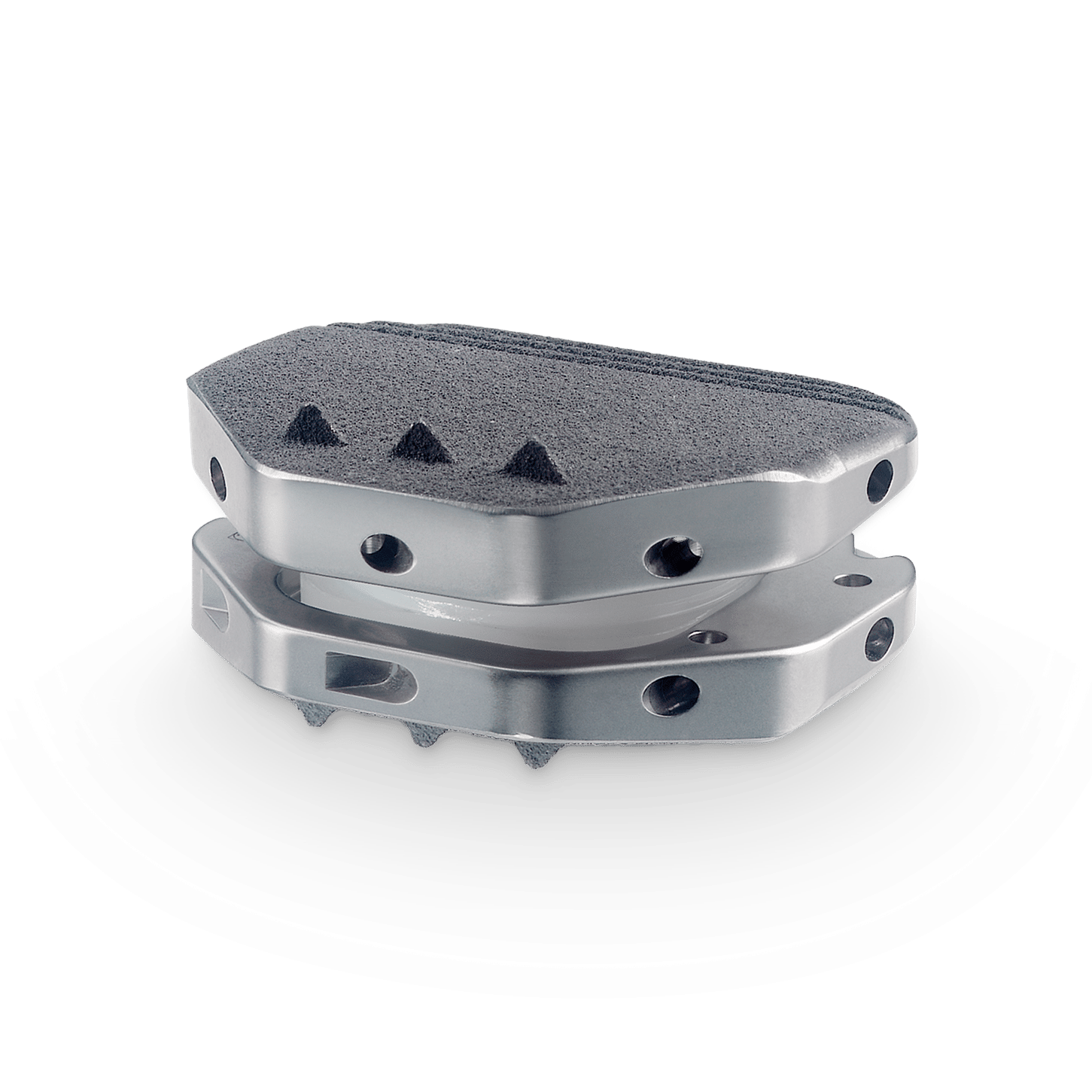
System Features
1. Intelligent Motion Technology™
activL is designed with four degrees of freedom, including controlled anterior-posterior translation. Its semi-constrained mobile core helps better replicate the spine’s natural axis of rotation, supporting controlled, physiologic motion at the treated level.
________________________________________
2. Broad Anatomic Fit
A wide range of footprints, heights, lordotic angles, and endplate options (keel or spike) allows surgeons to better match patient anatomy and surgical needs.
________________________________________
3. Advanced Fixation with PLASMAPORE®
PLASMAPORE®-coated endplates provide immediate mechanical stability, while a thin calcium-based layer encourages natural bone growth after surgery, supporting long-term implant integration.
________________________________________
4. Modular, Streamlined Design
The modular design allows surgeons to select and assemble the appropriate components during surgery for a precise fit. The device is then implanted as a single unit through an anterior approach.
Specifications
Implant Options
- activL® Spike Endplates
- activL® Keel Endplates
Footprints (Depth X Width)
- S: 26 × 31 mm
- M: 28 × 34.5 mm
- L: 30 × 39 mm
- XL: 33 × 40 mm
Lordosis Options
- Superior Endplate: 6° or 11°
- Inferior Endplate: 0°
- S1 Inferior Endplate: 5°
Heights (Polyethylene Inlay)
- 8.5 mm
- 10 mm
- 12 mm
- 14 mm
Resources
Brochures & Surgical Technique Guides
Indications, Contraindications, and Potential Adverse Events
Indications for Use
The activL® Artificial Disc (activL) is indicated for reconstruction of the disc at one level (L4-L5 or L5-S1) following single-level discectomy in skeletally mature patients with symptomatic degenerative disc disease (DDD) with no more than Grade I spondylolisthesis at the involved level. DDD is defined as discogenic back pain with degeneration of the disc confirmed by patient history, physical examination, and radiographic studies. The activL® Artificial Disc is implanted using an anterior retroperitoneal approach. Patients receiving the activL® Artificial Disc should have failed at least six months of nonoperative treatment prior to implantation of the device.
Contraindications
The activL® Artificial Disc should not be implanted in patients with the following conditions:
- Active systemic infection or localized infection near the surgical site
- Osteoporosis or osteopenia defined as DEXA bone mineral density T-score ≤ -1.0
- Allergy or sensitivity to the implant materials (cobalt, chromium, polyethylene, titanium, tantalum, or calcium phosphate)
- Isolated lumbar radiculopathy, especially due to herniated disc
- Chronic radiculopathy (unremitting pain with predominance of leg pain symptoms greater than back pain symptoms extending over a period of at least a year)
- Extruded disc material with sequestrum (i.e., free disc fragment)
- Myelopathy
- Spinal stenosis
- Spinal deformity such as scoliosis
- Spondylolysis/isthmic spondylolisthesis, degenerative spondylolisthesis > Grade I, or segmental instability
- Clinically compromised vertebral bodies at the affected level due to current or past trauma (e.g., current or prior vertebral fracture) or disease (e.g., ankylosing spondylitis)
- Facet ankylosis or facet joint degeneration
- Preoperative remaining disc height < 3mm
- Symptoms attributed to more than one vertebral level
- Abdominal pathology that would preclude an anterior retroperitoneal approach
- Involved vertebral endplate that is dimensionally smaller than 31mm in the medial-lateral and/or 26mm in the anterior-posterior directions
Potential Adverse Events
Risks associated with any surgical procedure:
- Anesthesia complications including an allergic reaction or anaphylaxis;
- Infection (wound, local, and/or systemic) or abscess;
- Wound dehiscence or necrosis;
- Edema;
- Soft tissue damage or fluid collections, including hematoma or seroma;
- Pain/discomfort at the surgical incision and/or skin or muscle sensitivity over the incision which may result in skin breakdown, pain, and/or irritation;
- Heart or vascular complications including bleeding, hemorrhage or vascular damage resulting in catastrophic or potentially fatal bleeding, ischemia, myocardial infarction, abnormal blood pressure, venous thromboembolism including deep vein thrombosis and pulmonary embolism, thrombophlebitis, or stroke;
- Pulmonary complications including atelectasis or pneumonia;
- Impairment of the gastrointestinal system including ileus or bowel obstruction;
- Impairment of the genitourinary system including incontinence, bladder dysfunction, or reproductive system complications;
- Neurological complications including nerve damage, paralysis, seizures, changes to mental status, or reflex sympathetic dystrophy;
- Complications of pregnancy including miscarriage or congenital defects;
- Inability to resume activities of daily living; and
- Death.
Risks specifically associated with lumbar spinal surgery using an anterior approach:
- Injury to surrounding organs and structures including the cauda equina, nerve roots, other neurologic structures adjacent to the spinal column, adjacent vertebrae, lymphatic vessels, blood vessels, soft tissue, dura, intestines, kidneys, or ureters;
- Neurological difficulties, including trouble with bowel and/or bladder function (including incontinence), sexual dysfunction (including retrograde ejaculation in males), muscle weakness or paralysis, changes in sensation (including numbness, dysesthesias, or paresthesias), chronic reflex sympathetic dystrophy, or pain;
- Back or leg pain;
- Epidural or retroperitoneal hematoma or fibrosis;
- Scarring, adhesions, or swelling including in the peritoneum;
- Hernia; and
- Meningitis.
Risks associated with a lumbar total disc replacement device (including the activL® Artificial Disc):
- Risks directly related to the device including malposition, migration/displacement, subsidence/loss of disc height, device breakage, device disassembly, or early or late loosening of the device. Any of these issues may cause pain or injury to surrounding organs and structures including the cauda equina, nerve roots, or other neurologic structures adjacent to the spinal column (which could cause pain, paralysis, numbness, or retrograde ejaculation in males) or blood vessel damage or erosion (which could cause catastrophic or fatal bleeding even in the late postoperative period);
- Deterioration in neurologic status;
- Development of new pain;
- Failure of the device to improve symptoms or function;
- Problems during placement of the device including trouble sizing the device, anatomical or technical difficulties implanting the device, or issues with the device instruments (e.g., bending or breakage) including the possibility that a fragment of a broken instrument may remain in the patient after implantation;
- Adverse reaction or allergy to the device materials (cobalt, chromium, polyethylene, titanium, tantalum, calcium phosphate) or device wear
- debris which may lead to an adverse reaction of the local tissues or chronic inflammation that may lead to implant loosening or failure of the device, osteolysis, tumor formation, autoimmune disease, metallosis, scarring, or other symptoms;
- Change in the alignment of the spine or loss of proper anatomic curvature, correction, height or reduction of the spine including spondylolisthesis, change in lordosis, or instability of the spine;
- Degeneration of other parts of the spine including the facet joints or adjacent discs;
- Spinal stenosis;
- Fracture of the surrounding vertebrae;
- Unintended bone formation (i.e., heterotopic ossification, annular ossification) that may result in bridging trabecular bone and may reduce spinal motion or result in unintended fusion at either the treated level or adjacent levels; and
- Device failure which may require a subsequent surgical intervention (including removal of the activL, revision, re-operation or supplemental fixation).
Additional Information
Contact Us
USA: 800 447-3625
To submit a complaint, please email SpineComplaints@highridgemedical.com
10225 Westmoor Dr., Westminster, CO 80021 USA
To obtain a copy of the current Instructions for Use (IFU) for full prescribing and risk information, please call 800 447-3625.
Legal Manufacturer
Highridge Medical
10225 Westmoor Dr.
Westminster, CO 80021 USA